 f I were to close my eyes and remember Wiggle William’s First Day of School, it would be the drone of box fans that first came to mind. I was in kindergarten in Ft. Worth, Texas, a school I remember as a rectangular Arts and Crafts home from the early 1900s, retrofitted to be a kindergarten. It was all tall ceilings, and hardwood floors, and built-in bookcases. It had one awful feature: an aged bathroom with black-and-white hexagon tiles and a tank suspended on the wall over the toilet.
That tank was ominous. I always thought it might come crashing down on my head. And that toilet roared when you flushed, like some monster out of the watery deep, howling its way down the pipes. Terrifying. I tried to go in there only once each day, which was challenging to the four-year-old bladder.
A Child’s First Lesson in Voluntary Urine Retention.
Anyway, one o’clock was naptime, and we all, each of us, pulled a nap mat out of a rack and then the blanket and pillow we had brought from home. We were allowed to nap anywhere on the floor we liked—in the classroom, in the sunny playroom, in the vestibule where the rack of coats hung opposite.
I liked the vestibule best. It had a long table on one wall opposite a flank of windows and the coats, and my best friend Shari and I would put our mats under the table, drape a blanket over the top, and make a tent. We whispered until we got sleepy, which was generally pretty quick because the box fan sang and gently blew the tent blanket, and we were full of food.
Naptime was 45 minutes. The teachers generally woke us up by putting a record on the record player. The one I remember best was “Tina the Ballerina,” but there were others, like “The Teddy Bears’ Picnic” and “Bingo.”
One day, however, it was Shari who woke me up. She was tap-tap-tapping my arm. When I opened my eyes, she stopped tapping, but she was wide-eyed and shuddering, stiff like she was afraid to otherwise move.
“What?” I remember asking.
“There’s a thing on you,” she whispered. She looked a little sick, a little like she was about to scream.
“What?” I looked down, expecting a spider or a cockroach or some other crawly eww thing.
It was a little green lizard. Specifically, it was one of the green anoles that populate my yard—and sometimes my house—now decades later. He must have been very young because he was tiny—maybe two inches long. Bright green. And perfect. Beautiful.
My mouth made a round O. I held very still. A lizard on me! A lizard chose me! It was like a benediction.
What to do? I knew naptime would be over soon, and the record would play, and everyone would bounce up, and the tiny, perfect lizard would have to scramble, and—here’s the thing—I went to school in a company of killers. In those days, indoors, any crawly thing was stomped on by the villains at my school. They were nice kids. Scrubbed kids. But they’d learned it from their parents. Swat it. Kill it. Step on it. Smoosh it. Some of them took real joy in the guts of a squashed thing.
I could hear the lead teacher, Miss Miller, walk into the classroom next to us. The record would be playing soon. If I got up as quickly as Miss Miller would expect, this little lizard would scramble, and I wouldn’t give him ten seconds before one of my classmates smooshed him. Shari, frozen, was watching me. I don’t think she would have killed him, but she was clearly scared of him, didn’t want to touch him at all.
What to do? What to do?
We heard the snap of the record player turning on.
Scared as she was, Shari rolled off her mat carefully, like the drop-and-roll procedure we’d been taught if we ever caught fire, but in slow motion. The lizard started a little, lifted his head, but didn’t move.
I looked at him. He seemed to look back at me, head tilted slightly. I remember his speculative gaze out of hooded eyes. I remember my heart twisted. He seemed so vulnerable at the same time his expression was aged and wise.
Any minute now, we’d be hearing “Tina the Ballerina” or “The Teddy Bear’s Picnic,” and at the moment I hated both ballerinas and teddy bears because the lizard, whom I had named Wiggle William in that flash of a moment, was doomed.
I did what any reasonable thinking pre-schooler would do. I snatched him up and shoved him down the neck of my dress.
Hooohh. Huh. He did not like that.
I felt him wriggling and tickling all around my torso. He could go no farther because the dress had a sash, and that sash was pretty tight around my middle, but still I was aware, aware that getting up was going to be dicey. I worked myself upright like a very old man after a very bad fall. I clutched my pillow to my gut. Pretty sure I looked shifty, too, like I was hiding something, which I was, and his name was Wiggle William for a reason because man, that tiny, sticky-fingered little thing could move.
“Time to get up!” called Miss Miller in the next room, Tina spinning around on the turntable.
“Time to get up!” she called again in the vestibule. She flicked on the lights and walked down the row of us, and I’m sure she saw both Shari looking nervous and me clutching my stomach like it hurt.
“You doing okay?” she asked me.
I had a bright idea. I would let Wiggle William out of the bathroom window, which was propped open because no house could withstand the energetic bowels of 22 children after lunch. Usually, we had to form a line.
I raised my hand. “Please, Miss, could I be first in line for the bathroom?”
It was a time when a raised hand and a “Please, Miss” went a very long way. It was a time when a pillow clutched to a tummy suggested hurry. She nodded, pointed to the door, and stepped away toward the next room.
Clutching my abdomen and feeling the scrabbly tickle of Wiggle William against my ribs, I fled to the bathroom, the terrifying bathroom with the flush so scary you’d be tempted to hold it all day.
Once inside, I nudged the door closed with my hips.
It took some untying and writhing to capture Wiggle William, now stuck firmly to the fabric near my shoulder. I snaked my hand up and somehow, improbably got him. I was fearful doing that because I had heard their tails pulled off, and even though I’d also heard the tails grew back, I didn’t really want to find out the hard way that the tails came off and — surprise!– the lizard bled out.
I looked at him, holding very still, peering out at me through a gap in my fingers. What goes through a captured lizard’s little brain? Prepare thyself for supper or jump for it if there’s any chance at all? I’ll never know. I do know I slipped my arm out the window, opened my hand, and he went for it, leaping wildly for the ligustrum just outside. He must have made it, because I saw the leaves on one branch shiver, shiver inward toward the center of the bush.
And then he was gone.
And now I had a choice to make. Slip out of the bathroom without the flush, which would make the teacher wonder and likely send the (poor, constipated) child back in later for a second attempt, or flush and face the monster.
I flushed.
I pulled the chain and flushed. The monster roared. The toilet swirled. I dashed a little water from the sink on my hands for further pretense, then fled out the door.
“Feeling better?” asked Miss Miller brightly.
“Yes ma’am,” I said. I sat at my desk, smoothed my skirt primly, and feigned nonchalance.
I looked at Shari, who was something of a rule follower and even more of a tattle, but she was my friend. She lifted her chin and looked away.
A Child’s First Lesson in Plausible Deniability.
I may have set him free, but Wiggle William was with me even so. I drew him for weeks after that. I put Wiggle William in various outfits and poses. Sometimes on a pirate ship. Sometimes flying an airplane with a long white scarf trailing away behind. Sometimes on a throne, with a crown, surrounded by a court of bugs. They were kid pictures indecipherable to an adult. But I knew. Wiggle William was the secret I would never tell a soul.
Until now.
© Susannah Charleson, 2026
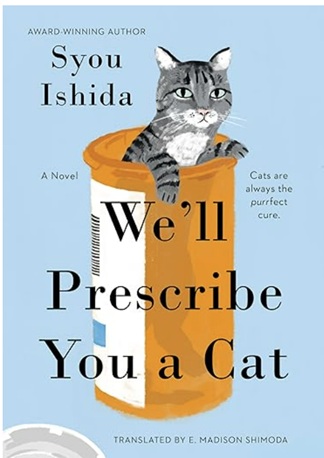 If the dog days of summer make listening to an audiobook in the cool sound good, might I suggest We’ll Prescribe You a Cat?
Here’s the bookseller blurb, followed by my take so far.
A USA Today Bestseller
A cat a day keeps the doctor away…
Discover the award-winning, bestselling Japanese novel that has become an international sensation in this utterly charming, vibrant celebration of the healing power of cats.
Tucked away in an old building at the end of a narrow alley in Kyoto, the Kokoro Clinic for the Soul can only be found by people who are struggling in their lives and genuinely need help. The mysterious clinic offers a unique treatment to those who find their way there: it prescribes cats as medication. Patients are often puzzled by this unconventional prescription, but when they “take” their cat for the recommended duration, they witness profound transformations in their lives, guided by the playful, empathetic, occasionally challenging yet endearing cats.
Throughout the pages, the power of the human-animal bond is revealed as a disheartened businessman finds unexpected joy in physical labor, a young girl navigates the complexities of elementary school cliques, a middle-aged man struggles to stay relevant at work and home, a hardened bag designer seeks emotional balance, and a geisha finds herself unable to move on from the memory of her lost cat. As the clinic’s patients navigate their inner turmoil and seek resolution, their feline companions lead them toward healing, self-discovery, and newfound hope.
I just began listening to the audiobook a few days ago. Narrated by Naruto Komatsu and Natsumi Kuroda, the story is gentle, listenable, and lively all at the same time, told beautifully and simply.